
Use the Data Health dashboard
Spot missing check-outs, unclosed time entries, unnotified incidents, and invoice gaps before they become compliance problems.
Data Health is the meta-report. It doesn't show you operational numbers — it shows you where your data has holes. Run it weekly so small issues don't compound into a licensing inspection nightmare.
Run it
- Reports → Data Health in the sidebar (it's at the top of the Compliance section).
- Pick center (or "All centers") and a date range (default: last 30 days).
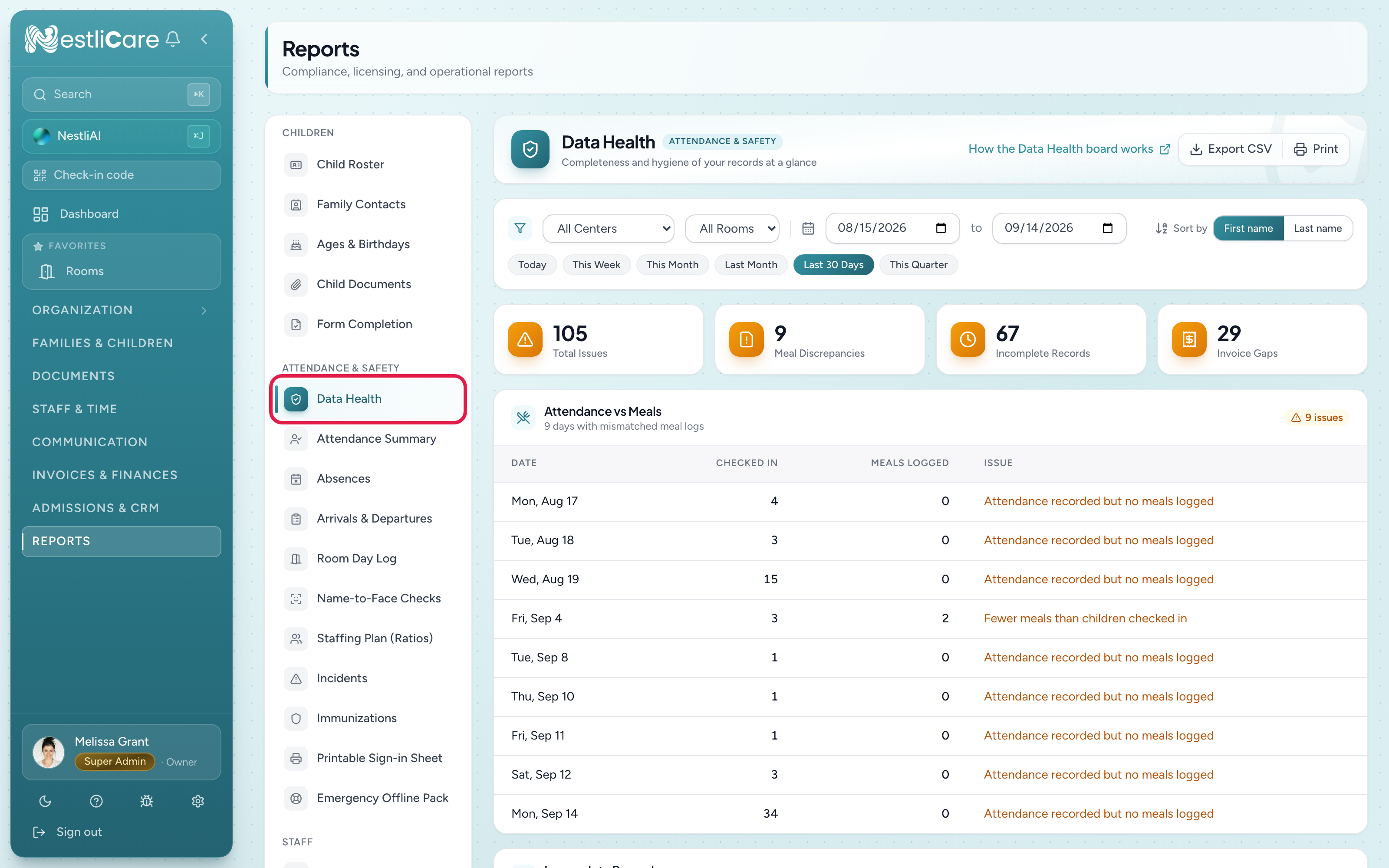
The four checks
1. Attendance vs Meals
For each day, compare children checked in vs. meal records logged. Issues flagged:
- Meals logged but no attendance — a teacher logged a meal for a child who was never checked in. Usually means someone forgot to check them in.
- Attendance recorded but no meals logged — kids were there but meals weren't logged. Either they weren't served (unusual) or logging was skipped.
- Fewer meals than children checked in — common at snack time when only some kids ate.
2. Missing Check-Outs
Children with a check-in timestamp but no check-out, and not marked absent. Each one is a compliance issue — every session needs a complete in/out audit trail.
3. Open Time Entries
Staff clock-ins that never got clocked out. Critical for payroll — an unclosed shift either:
- Auto-closes at 16 hours (inflating their hours), or
- Stays open forever (zero hours counted)
Close them yourself (Staff & Time → Timesheets → [person] → Edit) or chase the staff member to clock out properly.
4. Unnotified Incidents
Incident reports where Parent Notified is false and status isn't Closed. Every state requires parent notification — don't let these sit.
5. Invoice Gaps
Families with active enrollments but no invoice in the period. Either:
- Their billing plan hasn't been assigned yet, or
- The last billing cycle skipped them (data issue)
Worth checking each one.
Common use cases
Weekly "run it Friday" check
Most centers run Data Health every Friday afternoon:
- Filter to this week.
- Work down the sections:
- Fix any missing check-outs (ask teachers, or mark absent)
- Close any open time entries (review, approve, close)
- Notify parents on any unnotified incidents
- Fix any invoice gaps before the weekend
- You go into Monday with clean data.
Pre-inspection prep
Before a licensing visit:
- Filter to the past 30 days.
- Get every section to green.
- Screenshot the clean dashboard — some inspectors appreciate seeing proactive data-quality work.
After onboarding new staff
Newly hired teachers often forget to clock out for their first week. Run Data Health filtered to them (via center + date range) to catch clock-out gaps while you can still reconstruct accurately.
What "green" actually means
Each section shows a count. Green means 0 — no gaps. Amber means there are gaps but they're recoverable. Red on any section means something urgent (usually a spike in unnotified incidents).
This report has no export
Unlike other reports, Data Health has no CSV export and no print. It's an informational dashboard meant to drive you into the underlying records to fix them.
Click into each section — the rows link to the specific records (specific attendance entries, time entries, incidents, families) where you can take action.
No annotations either
Data Health doesn't support annotations — it's transient by nature. A note like "3 missing check-outs" is only useful until you fix them; no need to archive.
Troubleshooting
Data Health shows zero issues across the board. Either your data is actually clean (great!), or your date range is so small nothing's caught. Try a 30-day range.
Attendance vs Meals shows issues but I know meals match. Look at the per-day detail. Issue often is a timezone mismatch — check your org timezone in Settings → Organization.
"Unnotified Incidents" count isn't going down after I notify parents. Parent notification requires the Parent Notified flag to be set on the incident record. Check the incident, toggle the flag, save.
"Open Time Entries" shows entries from months ago. Those auto-closed at 16 hours but the autoClosedAt timestamp is set. They count differently than true open entries. Contact support if you want them archived.
Dashboard takes a long time to load. Data Health is the most expensive report — it runs 4 cross-checks. Narrower date range = faster load.